In our last article on Decentralized Finance (DeFi), we discussed its application to retail banking that banks and credit unions can take advantage of today to offer buy, sell, hold capabilities to their end users alongside other benefits. This time, we’re exploring more of how DeFi works as well as taking a look at how larger commercial and international banks can harness its power in new and exciting ways.
Why DeFi, again?
DeFi relies on cryptology and smart contracts to execute transactions under predefined conditions. This means that participants can make certain of the outcome of their exchange (making it trustless, no extra element of trust needed) without the involvement of a 3rd party (making it peerless). Because it is a product of blockchain technology, the workflow can become automated and trigger another action once conditions are met. Blockchain tech also allows for near instantaneous movement of assets without waiting for a bank transfer to process. Those without reliable access to a secure bank can therefore send and receive value instantly without one - something that was previously impossible.
While this lowering of barriers presents new opportunities for individuals, in the case of unbanked people or for use as remittance payments to developing countries, for instance, it can also revolutionize the way we think about corporate payments and interbank, international transfers. Not only could corporations pay for airplanes and property with Bitcoin, but banks could transfer funds with the cost and time-savings of DeFi, keep reserves in stablecoins (cryptocurrency-based, tokenized assets pegged to the value of an underlying asset, like the US Dollar, Japanese Yen, or gold), and more. While there are some popular stablecoins like Tether (USDT), some corporations have developed their own proprietary coins. Meanwhile central banks and governments have also been exploring Central Bank Digital Currencies (CBDCs) which in essence would serve as new crypto-based coin to replace or supplement the existing fiat currency (like a $USD CBDC that you could use for everything from buying a coffee to putting down a deposit on a new car).
Think this is all theoretical and won't happen? Think again -- In October, J.P. Morgan and Visa recently partnered to bridge their proprietary blockchain networks to better facilitate payments. Additionally, the US Government is exploring a CBDC of their own, along with many major world economies. It is quickly becoming not a matter of 'if' DeFi , it's a matter of when, and banks should be ready for the changes that are coming.
There’s a lot to explore with DeFi trends and opportunities for corporations and large banks. Let’s start with taking a look at Automated Market Makers.

Automated Market Makers & Project Mariana
Automated Market Makers, or AMMs, are a decentralized exchange of tokenized assets built with smart contracts and liquidity pools of said assets. Essentially, these can allow for the automated trading of assets, skipping more manual processes of matching buyers and sellers, instead converting the asset automatically. Central banks in Switzerland, Singapore, and France are exploring a system of smart contracts set up as automated market makers to exchange hypothetical CBDCs of the Swiss franc, euro, and Singapore dollar to settle foreign exchange trades. This would allow for automated cross-border payments between the three countries, and serve as a model for future exploration of CBDC governance and automation. Practically, this cutting out of extra steps in the trading process would save massive amounts of money and time as international transfers happen near-instantly with little additional cost, with full transparency available. As corporations and governments explore these ideas, one question might consistently pop up: What happens when two entities want to trade without a liquidity pool set up?
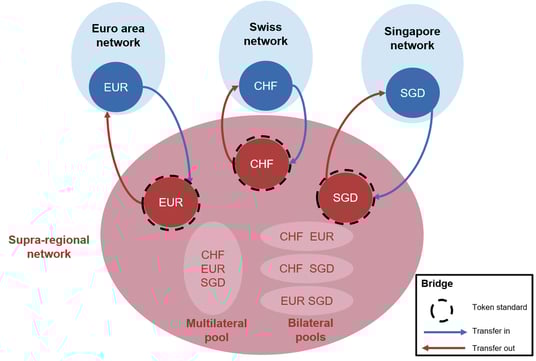
Project Mariana is just one application of DeFi technology.
DeFi unlocks new flexibility
While for larger systems like Project Mariana where the countries or companies involved are likely frequently engaging in trade of assets they set up the AMM for, there’s more flexible options for corporations or banks looking to engage in other types of transfer. For instance, if a bank wants to accept digital assets from corporations paying in cryptocurrency, other banks across the globe using a stablecoin pegged to foreign currency, in addition to other assets, they could implement a solution to instantly convert those assets to other cryptocurrencies or stablecoins, fiat cash, or put it in their own reserves managed by a qualified custodian. Companies like CryptoFi are already hard at work bringing these visions to life. This type of flexible offering would give banks the ability to efficiently and effectively work in the quickly changing international market.
Conclusion
DeFi has quickly been changing the global financial markets. Whether financial institutions want to start by offering a buy/sell/hold crypto feature set for their users or are thinking bigger with corporate payments, and crypto conversion, there is a lot that CryptoFi can help you with. Learn more at https://www.cryptofi.tech today!